Survive Your Ideas Disasters
Words stack; one safe spot does not solve every hazard.
Surviving one effect is not the same as surviving the round. The game description says words stack, so the route or shelter you choose has to account for what is already active.
The effect descriptions below come from published guides and public gameplay videos. They are useful for planning, but exact timing, hitboxes and current-version interactions have not been tested here.
On this page
Elevation
Tsunami: think about elevation
Guides describe a wall of water and recommends getting high or going underground. Treat those as reported responses, not proof that every elevated surface or underground spot is safe. See the Tsunami word guide for a step-by-step response.
The practical question is whether you can reach a suitable position before the water arrives. Existing threats may make a direct route unsafe. The source describes the effect as short-lived; this research does not establish a seconds-long countdown.
Shelter
Nuke: shelter is a different problem
Guides describe Nuke as a brief nuclear hazard and recommend a bunker. That is a different response from simply climbing upward. Do not assume the same exposed high point that helped with water is also the answer to a blast.
The available sources do not establish universal bunker immunity. In particular, the same word reference warns that Meteor can damage bunkers, which matters if both effects are present.
Ongoing pressure
Meteor: prepare for continuing danger
Meteor creates falling rocks. Keep watching incoming hazards and preserve a route away from your current position. Its lifetime is reported inconsistently, so do not assume it either expires after a set number of seconds or lasts the whole match.
Shelter damage is reported, so keep a backup route available. Read the Meteor effect and survival guide for more detail.
Lava, Earthquake, Tornado and Black Hole
In a gameplay video the LAVA hint reads “The floor is LAVA! Get off the ground - climb anything!” and the ground then turns red.
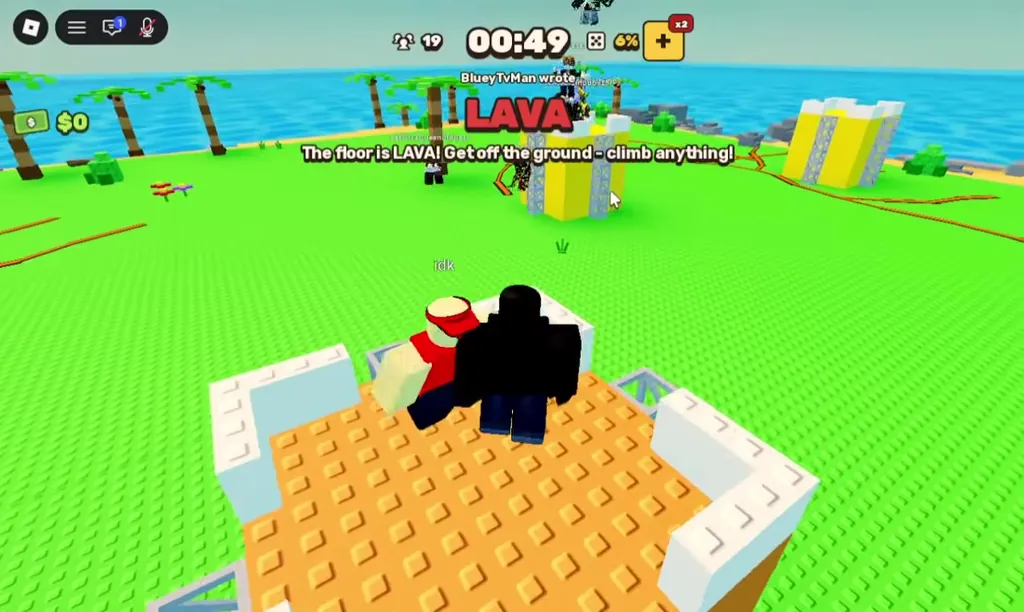
Guides describe Lava as dangerous ground, Earthquake as splitting terrain, Tornado as a map hazard, and Black Hole as consuming the map progressively. The descriptions suggest different threats, but they do not supply a verified route or precise timing for each one.
Avoid turning a descriptive name into a fabricated mechanic: this guide does not claim exact pull ranges, damage ticks or a tested escape pattern. The words reference keeps the effects and duration notes together.
Freeze, DONTSTOP and Blackout
FREEZE turns the ground to ice and warns you not to slide off the edge; DONTSTOP tells everyone to keep walking and stay away from the edge; BLACKOUT darkens the map and tells players to stay close to the light. Timings were not measured.
How long do disasters last?
Disaster effects do not share one universal timer. A next-Writer countdown marks a turn change, not an effect expiry. React to what is still active, and use a specific duration only when the effect itself has reliable timing information.
Do not count down an invented duration. Identify which effect is still present and whether another word has added a new threat.
Late in the match
Gameplay videos show a shrinking border, a “Final 3!” banner and the message “Writer shield won’t stop players”. With two players left, a “Duel! Write your word!” prompt appeared. The exact shrink timing and duel rules were not shown.
Is high ground always the best place?
No single position is supported as an answer to every effect. A water hazard, a blast and falling objects demand different considerations. Even a good response to one threat can become a poor response when words stack.
The on-screen hints for Lava and Zombies do point players to higher ground, but stacked effects and the shrinking border can still make a high spot unsafe.
A useful decision sequence is to identify the immediate threat, check whether the route itself is dangerous, and avoid assuming that a previous safe spot is still safe. That is an interpretation of the stacking mechanic, not a tested claim that any route guarantees survival.